Planning for an overseas market? Choose your country and local setup route. Check where you operate separately from where your customers live.
A one-page offer brief you can explain in thirty seconds.
A clear deliverable is easier to evaluate than a broad promise.
Start with a situation you understand
A useful offer starts with a problem you can describe precisely. “I help businesses grow” leaves too much unanswered. “I prepare a simple service page for independent tutors who currently explain their lessons in messages” gives the reader a situation to recognise. This is a fictional teaching example, not a client result.
List three requests people have already asked you about. For each, write what you can deliver, what information you need and what you cannot control. Choose the smallest task you can complete competently. If nobody has asked yet, speak with potential users before treating your idea as demand.
Write a scope that protects both sides
- Name one customer group and one immediate task.
- Describe a tangible deliverable: a page, a lesson, a document or a session.
- State what the customer must supply before work begins.
- Choose a realistic delivery window and revision boundary.
- Explain the next step without promising sales or income.
For the tutor example, the deliverable might be one service-page draft using the tutor’s existing information. Photography, advertising, lesson scheduling and guaranteed student enquiries are outside the example scope. State those boundaries before discussing a quote.
Use this offer brief
Copy and complete
I help [specific audience] prepare [deliverable] for [situation]. The service includes [three concrete items]. You provide [inputs]. We agree [timing and revisions] before work starts. To check whether this fits, send [one useful detail].
Read it aloud. Replace words such as “solutions” and “transformation” with something a customer could point to. Ask a trusted reader to explain what they think they would receive. A misunderstanding is useful feedback, not a reason to add more adjectives.
Decide what belongs in a tool
Systeme.io can give your offer a page and a way for interested readers to join a contact list. It cannot decide whether the service is valuable, set your professional boundaries or create proof of competence. Draft the brief in a document first; an existing website and a monitored inbox may be enough for the first conversations.
Keep a simple evidence list: sample work you created, relevant experience and customer comments you have permission to publish. Label demonstrations as samples. Do not fill an empty testimonial section with invented reviews.
Completion check
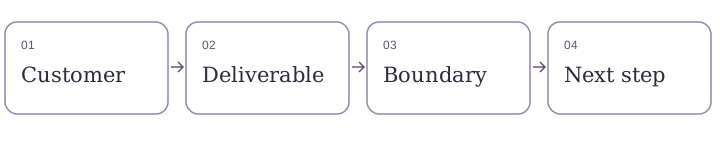
- A reader can identify the customer, deliverable and next step.
- The scope distinguishes included work from exclusions.
- Any price or timing statement is one you can actually honour.
- You have one unresolved assumption to ask a potential customer about.
If people understand the offer but do not need it, revise the problem or audience before investing in more pages. Your next task is to turn this brief into a readable page.
From principle to practice
Scope means the agreed boundary of the work: what is included, what the customer supplies and what is excluded. The useful habit is to make this explicit before adding another tool.
ANNOTATED EXAMPLE · FICTIONAL TEACHING SCENARIO
A small rewrite, a clearer decision
I help anyone build a successful online business.
I draft a one-page lesson introduction for independent tutors, using their existing service details and one round of revisions.
Why it helps: The revised version identifies a customer, a tangible output and a boundary. It still needs agreed timing and a price basis, but the reader can now ask a meaningful question.
Write two versions of your offer. Give both to a reader without explaining them. Ask what they expect to receive and which detail they would ask about before proceeding.
Do not promise more enquiries to make an unfamiliar service sound stronger. Promise work you can deliver and show the evidence you actually have.
Keep a record of what you changed. Separate what you observed from what you hope will happen. The worksheet below gives you a place to write the decision, test result and next action.
Should I choose a business name first?
A working name is enough for this exercise. A clear offer lets you test understanding before spending time on naming, branding or a larger website.
YOUR FREE COMPANION
Make this lesson your own
Download eight guided prompts for this task, or print the complete six-lesson workbook. No signup. No email gate. Save your answers in your own files.
Free to adapt for your own business. Examples are teaching aids, not legal forms or guaranteed business outcomes.
Where Systeme.io fits
Use a page builder once your offer is clear. A document is enough while you are still deciding what to sell.
You still supply the offer, useful content, visitors and customer care. Software does not guarantee customers or income.
Explore Systeme.ioWe may earn a commission if you buy through this link, at no extra cost to you. How recommendations are funded.
Sources and scope
Editorial teaching examples; not a report of a completed customer project or an end-to-end account test. Prepared 8 October 2026.
Check current official plan limits and billing options before choosing a subscription. No paid plan is required to complete the planning exercises. This guide does not quote prices or promise that every feature is included in your plan.