Planning for an overseas market? Choose your country and local setup route. Check where you operate separately from where your customers live.
Three editable email drafts and a sequence test plan.
Every email needs one reason to exist and one useful next step.
Map each email to a reader need
Start with the promise on the signup page. A person who requested a preparation checklist expects that checklist, not a surprise series about unrelated products. Give each message one purpose. The example below is an editorial exercise for a fictional tutoring service, not a tested sales sequence.
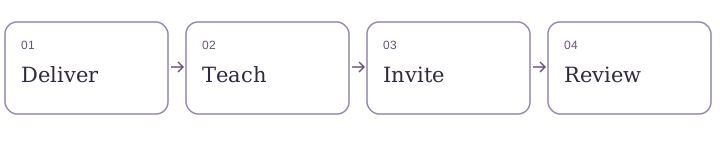
Suggested spacing is a delivery email first, a helpful tip two days later and an optional next-step invitation several days after that. Treat this as a starting assumption. Choose timing based on the reader’s task and the subscription description, not a claim that a particular interval guarantees sales.
Draft three messages
Email 1 — Deliver
Subject: Your lesson-preparation checklist
Thanks for requesting the checklist. Here is your download: [working link]. Start by listing the two topics you most want to understand. If the file does not open, reply here and I will help.
Email 2 — Make it easier
Subject: One way to prepare a useful question
Instead of writing “I do not understand this topic,” note the last step you could follow and the first step that confused you. Bring one example to your session. What part are you working on?
Email 3 — Offer a choice
Subject: Would a first-session conversation help?
If you would like to discuss lesson availability, see [service-page link] for the format and next step. If you are still preparing on your own, keep using the checklist. There is no need to book to use it.
Connect only the intended subscribers
Systeme.io’s official sequence guide describes creating an automation rule with a form-subscription trigger and a Subscribe to campaign action. Select the correct page and campaign, then save the rule. Build and review the campaign before connecting live signups.
Do not accidentally send the same welcome email from both a standalone delivery rule and the campaign. Map the resource-delivery responsibility to one place. A personal service enquiry should receive an appropriate reply; it should not silently start this marketing sequence.
Test before expanding
- Proofread all placeholders, reply addresses and links.
- Use a controlled test contact and note expected send times.
- Check that each message arrives once and in order.
- Reply to a message and confirm the reply reaches a monitored inbox.
- Unsubscribe the test contact and verify later marketing behaviour.
If a reader becomes a customer or says the offer is not relevant, review which future messages should stop. Advanced branching is optional; a clearly maintained manual process is better than automation you cannot explain.
Completion check
Ask whether each message remains useful without a purchase. Remove invented deadlines, exaggerated income claims and repeated “just checking in” reminders. Measure genuine replies and relevant enquiries alongside delivery problems. Opens alone do not establish that someone read or wanted the message.
- Each message does one distinct job.
- The sequence matches the signup explanation.
- Delivery and timing are checked with a test contact.
- Someone owns replies and unsubscribe problems.
From principle to practice
Sequence means a planned set of messages delivered in an order and at intervals appropriate to the subscriber’s request. The useful habit is to make this explicit before adding another tool.
ANNOTATED EXAMPLE · FICTIONAL TEACHING SCENARIO
A small rewrite, a clearer decision
Just checking in. Are you ready to buy? This is your last chance.
Here is one way to prepare your first question: note the last step you understood and the first step that confused you. Reply if you would like help choosing an example.
Why it helps: The revision adds something the reader can use. A reply becomes an option, not an obligation. Urgency belongs only where there is a real, explainable deadline.
For each draft, underline the sentence that helps the reader. If there is none, rewrite the message or remove it. Then check the timing and the reason the sequence should stop.
Avoid duplicate delivery. If the campaign sends the resource email, a separate rule should not send the same message again.
Keep a record of what you changed. Separate what you observed from what you hope will happen. The worksheet below gives you a place to write the decision, test result and next action.
How many emails are ideal?
There is no universal number. Three is a manageable drafting exercise, not a proven best-performing sequence. Use only as many messages as your promise and reader’s task justify.
YOUR FREE COMPANION
Make this lesson your own
Download eight guided prompts for this task, or print the complete six-lesson workbook. No signup. No email gate. Save your answers in your own files.
Free to adapt for your own business. Examples are teaching aids, not legal forms or guaranteed business outcomes.
Where Systeme.io fits
Systeme.io can organise scheduled campaign delivery. It does not replace useful writing, permission or a person who answers replies.
You still supply the offer, useful content, visitors and customer care. Software does not guarantee customers or income.
Explore Systeme.ioWe may earn a commission if you buy through this link, at no extra cost to you. How recommendations are funded.
Sources and scope
Editorial teaching examples; not a report of a completed customer project or an end-to-end account test. Prepared 8 October 2026.
- Official campaign automation instructions — checked 8 October 2026.
Check current official plan limits and billing options before choosing a subscription. No paid plan is required to complete the planning exercises. This guide does not quote prices or promise that every feature is included in your plan.